Showing posts with label Economics. Show all posts

Sunday, November 28, 2010

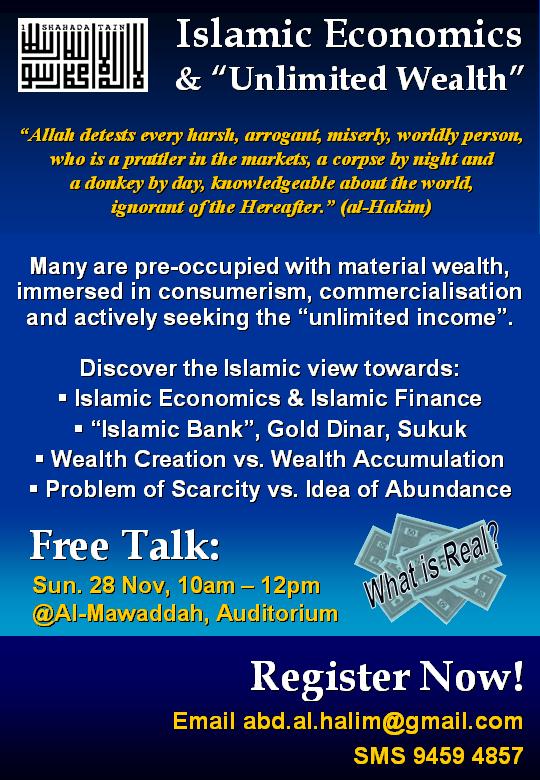
Islamic Economics & The Idea of "Unlimited Wealth"


[Source courtesy of Sheikh Abdul Halim Abdul Karim]

AlhamdulilLah, I attended a talk by Sheikh Abdul Halim on 28 Nov and what I took away from this talk is the need to operationalise the Tawhidic paradigm fully in one's life.

To be committed to submit and subject oneself to pattern one's life in accordance to the will of Allah SWT seems like a daunting task for many especially if there is confusion at the level of knowledge, confusing terminologies prescribed by the Western and/or Secular worldview with that of Adeenul Haq. What Sheikh did was to highlight the comparison in the effort to create an awareness of the need to seek clarity especially at the level of definitions.

Truly the evil in duniya lies in its quality to distract us, nauzubillah! One have to be mindful in differentiating between illusion and illusory - there is neither real scarcity nor abundance; only problem with availability and distribution... as a result of man's greed.

Indeed, mankind needs to be more al-Ghaniy (devoid of needs) but of course in another sense, we are all in need of Allah's mercy and redha, making us Faqir, subhan Allah. Truly everything shall return to Allah Azza wa Jalla. Zuhud is not a term one knows but to embrace it as part of one's life, so do not despair and remain hopeful by perpetually seeking Allah's help for us to get there, insya Allah ameen ya Rabb.

Let me end this post with some beautiful verses and hadith shared by Sheikh Abdul Halim as a point of introspection:

Preoccupation with this world - "The Day of Judgment has come close, and mankind will only increase their desire for this Duniya (world), and they will only go farther and farther away from Allah." [Reported by al-Hakim, who declared this is hadith saheeh]

Hadith on wealth - "The plentiful i.e. the rich will be the lowest on the Day of Judgment, except he who distributed his money left and right i.e. at all times, while he earned from pure means." [Reported Ibn Majah, et. al. Al-Busayri: This is hadith saheeh]

Life of Duniya is temporary - "And coin for them the similitude of the life of the world as water which We send down from the sky, and the vegetation of the earth mingleth with it and then becometh dry twigs that the winds scatter. Allah is Able to do all things." [QS al-Kahf: 45]

Hereafter is better, more enduring - "He is successful who groweth. And remembereth the name of his Lord, so prayeth, but ye prefer the life of the world although the Hereafter is better and more lasting." [QS Al-Ala: 14 -17] 

Wednesday, May 19, 2010

Philosophy of Islamic Ecnonomics - 19 May 2010


[Source courtesy from 1Islam.net]

AlhamdulilLah, tonight Sheikh Abdul Halim covers the history of moneyhistory of bankingfractional-reserve banking and the importance of understanding the true Islamic banking and economics.

One will soon realise that without 'ilm (knowledge) in this era of fitan, some 'islamic banks' are actually "wolves in sheeps' clothing", as rightly pointed by Sheikh Imran Hosain in the video above.

Wednesday, May 12, 2010

Philosophy of Islamic Economics - 12 May 2010

"Lord of the East and the West; there is no God save Him; so choose Him alone for thy defender" [Surah al-Muzzammil: 9]

Tonight's lesson was on Islam and Globalisation, whose definition of 'Globalisation' is separate from the Western Worldview. Subhan Allah, Islam is truly a universal religion that transcends all borders. I agree with Sheikh when he said that the common denominator for our Ummah is Islam and to be part of this privileged 'membership' is a great ni'mah (gift). Indeed, when the Ummah come together from a variety of nationality, race and culture to ta'kruf and learn from each, therein lies Allah's wisdom:

"It is not righteousness that ye turn your faces to the East and the West; but righteous is he who believeth in Allah and the Last Day and the angels and the Scripture and the prophets; and giveth wealth, for love of Him, to kinsfolk and to orphans and the needy and the wayfarer and to those who ask, and to set slaves free; and observeth proper worship and payeth the poor-due. And those who keep their treaty when they make one, and the patient in tribulation and adversity and time of stress. Such are they who are sincere. Such are the God-fearing." [Surah al-Baqarah: 177]

Truly, Islam is for all mankind - inclusivism (a religion for all) and exclusivism (the final revelation). Then, Islamic Economics is a regulated system about just distribution of resources benefitting all i.e. not to be at the mercy of any corporations. In essence, Islam advocates fair trade. I'll end this post by sharing an article on fairtrade here.

Afternote: This quote sticks in my head - "A decent provision for the poor is the true test of civilisation", subhan Allah.

Wednesday, May 05, 2010

Philosophy of Islamic Economics - 5 May 2010

AlhamdulilLah, Sheikh discusssed Riba (Usury), Gharar (Doubtful or uncertain risk) and Maisir (Gambling) with the class. He started with Al-Amr bi al-Ma’ruf wa al-Nahy ‘An al-Munkar (inviting to all that is good, enjoining what is right and forbidding what is wrong) and this particular duty is profusely mentioned in the al-Quran and al-Sunnah. Among the verses is when Allah says (translated as):

“And the believers, men and women, are protectors one of another: They enjoin what is good, and forbid what is evil; they observe regular prayers, practice regular charity, and obey Allah and His Messenger. On them will Allah pour His Mercy: for Allah is Exalted In power and Most Wise.” (Surah al-Taubah: 71)

In terms of Halal and Haram in Economics, he demonstrated by way of Surah An-Nisa: 29 - "O you who believe! Eat not up your property among yourselves in vanities: but let there be amongst you traffic and trade by mutual good-will: nor kill (or destroy) yourselves: for verily Allah hath been to you Most Merciful."

In terms of Riba' in the Quran, Surah Ar-Rum: 39 - "That which you lay out for increase through the property of (other) people, will have no increase with Allah: but that which you give for charity, seeking the Countenance of Allah (will increase): it is these who will get a recompense multiplied."

Many other evidences in the Quran rejects Riba' (usury) such as Surah Ale Imran: 130, Surah Al-Baqarah: 275 - 281. Reflecting on these and a hadith narrated by Ibn Majah - "RasululLah SAW cursed the one who receives, pays, witnesses and the one who documents Riba'" (Narrated by al-Darimi), I could not fathom how the Ummah can cooperate or participate in a system that propagates this and incur the curse of our beloved Prophet SAW? Anyway, read this article for details on Riba (I just learned that there is 70 segments of Riba', subhan Allah).

Gharar (doubtful or uncertain risk), in essence, happens when a party has no control over whether he can deliver what he is selling, when there is inadequate or inaccurate information, when there is undue complexity of the contract, and/or when the terms of contract is unclear. This article covers the permissible gharar and this article covers Business Financing in Islam.

Maisir (gambling) is a zero sum game as reflected by Surah al Maeda: 90-91 - "O you who believe! Intoxicants and gambling, (dedication of) stones, and (divination by) arrows, are an abomination― of Satan's handiwork: eschew such (abomination), that you may prosper. Satan's plan is (but) to excite enmity and hatred between you, with intoxicants and gambling, and hinder you from the remembrance of Allah, and from prayer: will you not then abstain?". Critics may claim that Maisir (gambling) is different from speculation. Read this article to find out the truth.

Afternote: Islam is truly a religion that advocates Social Justice, encouraging its Ummah to transact real value vs. perceived value so as to avoid creating liability for any party. I'm constantly reminded that the Ummah's aim on earth is to create wealth, not to accumulate wealth, subhan Allah. Indeed, what is the point of circumventing the law when Allah SWT is All-Knowing of what is planted in one's heart?

Wednesday, April 28, 2010

Philosophy of Islamic Economics - 28 Apr 2010

"O ye who believe! Shall I show you a commerce (bargain) that will save you from a painful doom? You should believe in Allah and His messenger, and should strive for the cause of Allah with your wealth and your lives. That is better for you, if you did but know. He will forgive you your sins and bring you into Gardens underneath which rivers flow, and pleasant dwellings in Gardens of Eden. That is the Supreme Triumph." [Surah as-Saff: 10-12]

The class started with the brief definition of Islam as ad-Deen, with "Deen" coming from the root word "Daana" which means indebtedness, subhan Allah. Befitting as Sheikh Abdul Halim covered Muamalat (Law of Transaction and Trade), Investment and the Muslim as the Economic agent.

There was a comparison between free traders (regard 'voluntariness' as the chief component of justice) vs. fair traders (regard the expression of human dignity as the chief component of justice). If we take the angle of social justice, the latter wins (as it is closer to Muamalat!) - fair traders think that opening free trade even further would entrench trends of rich nations becoming richer and poor nations becoming poorer and that global prosperity cannot forget to include the immediate needs of those in the least well off group.

Then Sheikh covered the 5 basic principles of Investment - invest in a company that is halal (permissible), no guarantee of profits based on capital, no element of Gharar (uncertainty), no elements of Riba' and there should be mutual consent between the involved parties. In my humble opinion, it is a challenge to comply to all 5 principles of investment especially since earning a passive income (wealth accumulation) is not permissible vs. wealth creation per se.

What was important was the principles Muslim Economic agent have to adhere to and this can be summed up by Surah at-Tawbah: 59 and 111:

"(How much more seemly) had they been content with that which Allah and His messenger had given them and had said: Allah sufficeth us. Allah will give us of His bounty, and (also) His messenger. Unto Allah we are suppliants."

"Lo! Allah hath bought from the believers their lives and their wealth because the Garden will be theirs: they shall fight in the way of Allah and shall slay and be slain. It is a promise which is binding on Him in the Torah and the Gospel and the Qur'an. Who fulfilleth His covenant better than Allah? Rejoice then in your bargain that you have made, for that is the supreme triumph."

Afternote: A note to me - Put your life in Allah's hands and ikhtiyar towards attaining His barakah, truly that is sufficient for you :)

Wednesday, April 21, 2010

Philosophy of Islamic Economics - 21 Apr 2010


[Surah at-Taghabun]

As I reflected especially on ayat 13 to 18 of Surah at-Taghabun, I took away from tonight's lesson the need to remain consciously zuhd - Imaam Ibn Al-Qayyim, may Allaah have mercy upon him, defines zuhd as: "Zuhd is abandoning what does not bring about benefit in the Hereafter. Wara' is abandoning what you fear will have consequences in the Hereafter. This statement is one of the best and most comprehensive definitions of Az-Zuhd and Al-Wara'."

Surrounded by material wealth thick in the midst of a society that embraces consumerism blindly, it seems like a challenging task. Nonetheless, with what little knowledge I gained from Tawasuur Islam (alhamdulilLah), I reflect on the sayings of Sayidinna Ali RA and it is coming full circle for me - that if you worship Allah SWT out of your love for Him, this is indeed the worship of free and noble men, subhan Allah.

It makes perfect sense to be close to Allah SWT as outlined by Surah ar-Rad: 26 - "Allah enlargeth livelihood for whom He will, and straiteneth (it for whom He will); and they rejoice in the life of the world, whereas the life of the world is but brief comfort as compared with the Hereafter."

There may be critics who say that life of luxury is not wrong. Yes, it is not Haraam and one has a choice to be in this world or of this world (detachment vs. indifference)... truly Allah SWT dislike those who live in excess, blind to the needful. And one's self-worth is not based on one's possessions but tawakal alalLah (true conviction that all in the heavens and the earth belongs to Allah Azza wa Jalla). I end with this nice post by Abdal-Hakim Murah which Sheikh shared with us on a warning we should heed.

Afterthought: I'm constantly reminded to be more conscious when buying what I need vs. what I want, how I dispose off my hard-earned income to the rightful as I continue to seek Allah's barakah in all that I do, insya Allah. Truly all that I have in my hand is but a 'loan' from Allah SWT and it is my amanah to spend it in the way which pleases Him. May Allah SWT protect me, my family, future generation and Ummah from the Hellfire, ameen ya Rabbal A'lamiin.

Wednesday, April 14, 2010

Philosophy of Islamic Economics - 14 Apr 2010


Reflecting on the words of The Last Sermon (above) really brought home a lot of pointers, among which, we are all one family and as a family, we have the amanah to take care of each other. More importantly, we are to collectively fight whispers of Syaitan and refrain from doing small mischief which could lead to bigger mischief (truly all 'ilm belongs to Allah SWT and Allah Azza wa Jalla Knows what is best for us so sami'nah wa ato'nah and refrain from being like the Jews who think that they can circumvent the rules ordained by Allah SWT... oh how wrong were they). And that there is truly no new faith after Islam (the religion is complete) so hold firmly to the Quran and Sunnah (as these will save you from the Hellfire), subhan Allah.

In class, Sheikh Abdul Halim outlines the true definition of ownership rights in Islam. The contemporary thinker of Islamic Economics, Dr Monzer Kahf has good articles on this topic. Indeed, Islam is so beautiful. It is not interested in wealth accumulation (deem as a selfish act), rather it is welfare-driven and advocates wealth creation (no such thing as passive income coz truly productivity is synonimous with barakah) so that there is no idleness, non-utilisation or wastage of resources provided by Allah SWT.

From the Western Worldview's discussion on human nature, behavioural economics (based on prospect theory which in my opinion is unethical as the speculation is centred on the self-interest of the seller i.e. to make a profit) claim that man is irrational in his buying pattern as such there are opportunities to manipulate such buying behaviour. In Islam, man is the most superior creation by Allah SWT - "Surely We created man of the best stature" [Surah at-Tin: 4] - who has the fitrah saleemah and the faculties to reason and ikhtiyar between a good and a better option in order to suppress one's nafs and purify one's soul in his ibadah to Allah Azza wa Jalla, subhan Allah!

The discussion on the price equilibrium was an interesting one as the question revolves around who sets the price and how is the price set. Indeed in Islam, we are not concerned with price equilibrium or profit maximisation, rather we advocate 'adl (justice) in ascribing economic value - "Give full measure, and be not of those who give less (than the due). And weigh with the true balance. Wrong not mankind in their goods, and do not evil, making mischief, in the earth. And keep your duty unto Him Who created you and the generations of the men of old." [Surah al-Shuara: 181-184]

In my humble opinion, in every deed that we do, the sincerity of our niat is key (purity of the soul for the love of Allah SWT). Truly, we do not exist for this world alone. Allow me to end this long post by sharing the following good reads:
- Economic justice: Islam versus capitalism by Dr Mohammad Malkawi
- Islamic economic system by Dr Muhammad Sharif Chaudhry

Wednesday, April 07, 2010

Philosophy of Islamic Economics - 7 Apr 2010

Following up from the first lesson, this video highlights the dire need to live a halal living:


In Islamic Economics, it is not just about "I, Me and Myself", it comprises Shariah, Adl (Justice), Falah (Progress), man's relationship with 'Alm (Creation), Hablu minalLah (man's relationship with Allah SWT), Hablu minaNas (man's relationship with the rest), Ubudiyyah (Servitude) and Ummah (Community), subhan Allah. Islam is truly beautiful if we understand that we are custodian's of Allah's wealth.

On the contrary, the Western Worldview advocates Consumerism. This next video clip highlights that post World War 2, Victor Leibow, an economist and retail analyst said of US economy, "Our enormously productive economy ... demands that we make consumption our way of life, that we convert the buying and use of goods into rituals, that we seek our spiritual satisfaction, our ego satisfaction in consumption... we need things consumed, burned up, replaced and discarded at an ever-accelerating rate." .

He claimed that ultimately producing consumer goods through planned obsolescence and perceived obsolescence (designed for the dump) is the way to go... but findings later show that having more stuff does not equate to happiness even if we are constantly on the "work -> watch -> spend" treadmill... as we spend less time with what really matters. This article further reinforces that the Consumer culture is no accident.

Afternote: I recalled Sheikh Abdul Halim cautioning us during our Tasawwur Islam's class that although we live in a secular society, Muslims have a choice - to be part of the 'rat-race' or not to be the 'rat' at all, as our Islamic Worldview's paradigm is separate from Western Worldview, especially in defining sa'adah (happiness), subhan Allah.

Wednesday, March 31, 2010

Philosophy of Islamic Economics - 31 Mar 2010

AlhamdulilLahx3, following up from the Tasawwur Islam course, equipped with a changed mindset, it enabled me to see that the Islamic Economics is a separate paradigm from the conventional Economics outlined by Sheikh Abdul Halim.

Abu Hurairah (May Allah be pleased with him) reported: The Prophet SAW said, "Richness is not the abundance of wealth, rather it is self-sufficiency.'' [Source:Al-Bukhari and Muslim].

View this video, which outlined wealth, financial independence and patience in Islam:


[Source courtesy of Al Kawthar Academy]

To get one started, read this article by Dr S. M. Hasanuz Zaman and if you like what you read, get the book "Economic Guidelines in the Quran" for further reading.

Afternote: As mankind has taklif (to be accountable for one's deeds in Hereafter), it is essential to earn a 'clean income’ to gain barakah from Allah SWT for self-sufficiency as what goes into our bodily system shall be halal (permissible) and taiban (good) as I can't imagine prostrating to Allah Azza wa Jalla without a 'clean system', which technically is 'on loan' to us from Allah SWT and if we can do that, the rest will fall into place coz truly justice is synonymous with Adab. Wallahualam bissawab. The good comes from Allah SWT and the bad comes from me.